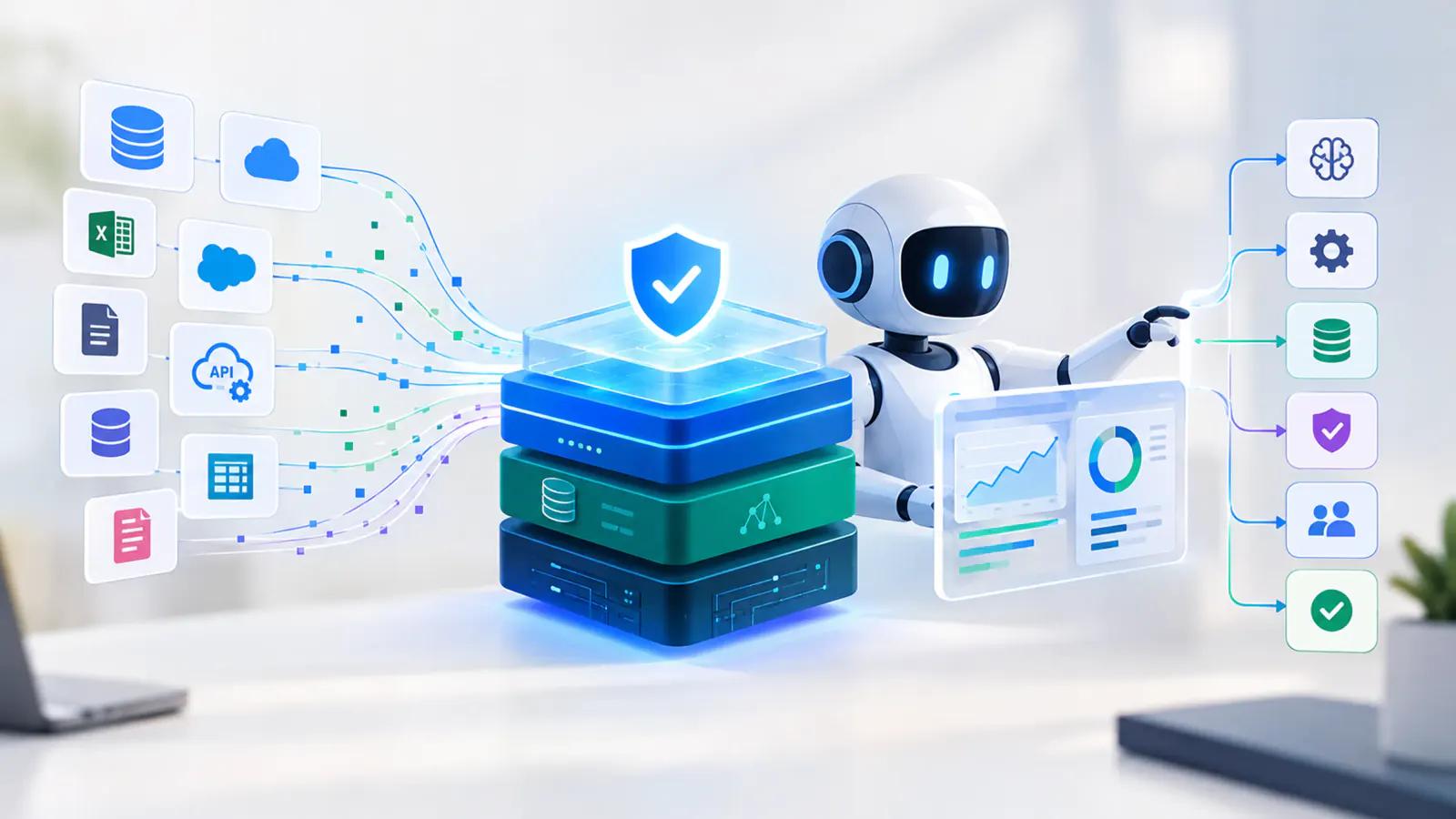
Quick Summary: Agentic AI can fail even when its models work perfectly. The reason? Unreliable data, broken pipelines, weak governance, and uncontrolled access. Discover how to build an AI-ready data foundation using data contracts, observability, lineage, and secure pipelines. Learn the practical steps you need to take before scaling autonomous AI workflows in 2027.
An AI agent can reason correctly and still make the wrong decision if the data behind it is stale, incomplete, poorly governed, or inaccessible. That is why data engineering consulting is becoming an important part of preparing enterprise AI for production, not because businesses need more data, but because they need data that AI systems can reliably understand, access, verify, and act on.
This matters as agentic AI moves from experiments to operational workflows. McKinsey's 2025 global AI survey found that 23% of respondents said their organizations were already scaling an AI agent somewhere in the enterprise, while another 39% were experimenting with agents.[1]
But there is a significant readiness gap.
A 2026 survey from Modern Data found that 57.3% of respondents were already piloting or running AI agents in data and analytics workflows, yet only 8.4% said the data feeding their AI systems was trustworthy enough for production.
That gap explains why the next AI challenge is not simply choosing a better model or agent framework. It is building a data foundation that an autonomous system can safely depend on.
So, how do you prepare enterprise data for agentic AI?
1. Why Agentic AI Projects Fail at the Data Layer
An AI agent is different from a traditional analytics application.
A dashboard may display yesterday's sales figures. A chatbot may summarize a document. An agent, however, can retrieve information, make a decision, call a tool, update a system, or trigger the next step in a workflow.
That means bad data can become an incorrect action.
Consider an AI agent handling customer service:
- The customer asks about an order.
- The agent retrieves the order record.
- It checks inventory and payment status.
- It determines whether a refund is appropriate.
- It initiates the refund.
If the order database is 24 hours behind, the inventory status has changed, or the customer record contains conflicting information, the agent can execute a perfectly logical process using incorrect inputs.
What Should You Check First?
Before deploying an agent, examine four basic areas:
-
Freshness: How recently was the data updated?
-
Completeness: Are the fields required for the decision available?
-
Consistency: Do different systems agree on the same customer, product, order, or transaction?
-
Traceability: Can you determine where the information came from?
This is where data lineage becomes important. An enterprise should be able to trace an important answer or action back through the pipeline to its source.
For example:
Agent decision → retrieved data → transformed dataset → source system → original record
Without that chain, investigating an incorrect AI decision becomes much harder.
Why Does a Working Model Not Guarantee a Reliable AI System?
Because the model is only one component.
A production agent typically depends on:
User request → agent → retrieval/tool selection → data pipeline → enterprise data → business rules → action
A problem anywhere in that chain can affect the final outcome.
The model may be functioning exactly as designed while the surrounding data infrastructure is failing.
That is why AI readiness should be assessed at the system level rather than by asking only whether the selected model performs well in a benchmark.
2. How to Build the Data Prerequisites for Production-Ready AI Agents
The first practical step is to create a data readiness checklist before connecting an autonomous agent to production systems.
At minimum, evaluate the following:
This checklist is more important than simply asking whether a company has a data warehouse or lakehouse.
An organization can have a modern data platform and still lack the controls required for autonomous AI.
How Do Data Contracts Prevent AI Pipeline Failures?
A data contract is an agreed definition between the team producing data and the teams or systems consuming it.
For example, an order dataset might require:
-
order_idto always exist -
customer_idto follow a defined format -
order_statusto use approved values -
timestamps to follow a defined timezone
-
schema changes to be versioned
The contract can then be tested automatically in the pipeline.
If a producer changes order_status from a controlled set of values to an unexpected structure, the pipeline can reject or flag the change before the downstream AI workflow uses it.
The important idea is simple:
Do not allow an AI agent to discover data-quality problems after a production action has already started.
How Do You Prevent Schema Drift?
Schema drift happens when the structure or meaning of data changes without downstream systems being prepared for it.
For example, an application might originally return:
customer_name
customer_email
customer_phone
and later change the field customer_phone to a nested object containing multiple phone numbers.
A human reviewing the change may understand it immediately. An automated agent or tool expecting the original structure may not.
A stronger approach combines:
-
versioned schemas
-
automated validation
-
CI/CD checks
-
data contract enforcement
-
backward-compatibility rules
-
alerts for unexpected structural changes
The objective is not to prevent every change. It is to make changes visible and controlled.
3. How to Build AI-Ready Data With Observability and Lineage
Data quality checks tell you whether data meets certain rules.
Observability goes further by helping you understand what is happening across the data environment.
What Does Data Observability Mean for AI Systems?
Think of it as a monitoring layer for your data pipelines.
It can track signals such as:
-
freshness
-
volume
-
missing values
-
duplicate records
-
schema changes
-
pipeline failures
-
unusual distributions
-
upstream and downstream dependencies
For an AI agent, these signals can become operational safeguards.
Suppose an agent normally retrieves 50,000 customer records each morning, but suddenly receives 4,000.
The pipeline may technically succeed.
But the change could indicate:
-
a failed source connection
-
a filtering error
-
an upstream application change
-
a broken transformation
-
incomplete ingestion
Without monitoring, the agent may continue operating with an incomplete dataset.
How Should You Monitor Data Used by AI Agents?
Start with business-critical data products rather than monitoring everything equally.
For each dataset, define:
Freshness SLA → quality checks → anomaly thresholds → owner → alert → response
For example:
Customer transactions must be refreshed every 15 minutes. A delay beyond 30 minutes generates an alert. A drop in record volume greater than 20% triggers investigation.
This makes data quality measurable instead of subjective.
Why Does Data Lineage Matter to Agent Decisions?
Suppose an AI agent recommends rejecting a transaction.
A production-grade environment should help answer:
-
Which data did the agent retrieve?
-
From which source?
-
When was that data captured?
-
Which transformation changed it?
-
Which business rule applied?
-
Which model and prompt version were used?
-
What permissions did the agent have?
-
What action did it ultimately take?
That creates an audit trail instead of a black box.
For high-impact use cases, lineage should ideally extend down to the relevant fields or columns rather than stopping at the table level.
4. How to Choose the Right Data Pipeline for Agentic AI
Not every AI agent requires real-time data.
The right architecture depends on how quickly the underlying business state changes and how quickly the agent needs to respond.
When Should You Use Batch Pipelines?
Batch processing works well when information changes relatively slowly.
Examples include:
-
monthly financial reporting
-
historical analytics
-
employee training records
-
long-term sales analysis
-
periodic inventory reporting
If an agent is answering a question about last quarter's performance, real-time ingestion may add complexity without meaningful benefit.
When Should You Use Streaming?
Streaming becomes more useful when business events need to be processed continuously.
Examples include:
-
fraud detection
-
machine monitoring
-
delivery tracking
-
payment events
-
customer activity
-
operational alerts
Tools such as Kafka can move events between systems as they occur, while orchestration and transformation tools such as Airflow, Dagster, and dbt can support broader data workflows.
When Does Change Data Capture Make Sense?
Change data capture, or CDC, captures changes made to operational databases rather than repeatedly copying entire datasets.
Imagine a customer changes their address.
Instead of waiting for the next full database export, CDC can capture the update and send that change downstream.
This is useful when an AI agent needs relatively current operational state.
A simple decision framework is:
The key is not to make every pipeline real-time.
Match data latency to the decision latency the business actually requires.
5. How to Give AI Agents Context They Can Reliably Use
Even accurate data can be difficult for an AI agent to interpret if the business meaning is unclear.
Consider two departments using the term "customer."
Sales may define a customer as someone with an active account.
Finance may define a customer as an entity with a completed transaction.
Support may define a customer as anyone with an active service relationship.
If an AI agent simply searches across these datasets, it may combine definitions that were never intended to be used together.
Why Does a Semantic Layer Matter?
A semantic layer provides governed definitions for business concepts, metrics, relationships, and calculations.
Instead of allowing an AI system to invent how two datasets should be joined, the semantic layer can provide approved relationships.
For example:
Customer → Account → Order → Payment
can be defined as a governed relationship rather than leaving the agent to infer it.
This becomes particularly important when agents generate SQL or select tools dynamically.
How Is a RAG Pipeline Different From an Agent-Ready Data Pipeline?
A RAG pipeline retrieves relevant information for a model to use as context.
An agent-ready data pipeline has broader responsibilities because an agent may need to:
-
retrieve current information
-
verify permissions
-
combine multiple sources
-
apply business rules
-
call tools
-
update systems
-
record actions
RAG is therefore one component of an agent architecture, not the complete data foundation.
Where Do Vector Embeddings Fit?
Vector embeddings convert content into numerical representations that allow systems to retrieve semantically similar information.
For documents, a typical process looks like:
Document → extraction → cleaning → chunking → metadata → embedding → vector index → retrieval
But embedding the document is not enough.
The system should also retain metadata such as:
-
document owner
-
department
-
creation date
-
version
-
confidentiality level
-
permitted users
Otherwise, an agent may retrieve a relevant document that the requesting user should never have seen.
6. How to Control AI Agent Access to Enterprise Data
An AI agent should not automatically receive every permission available to the human or application that created it.
The safer principle is:
Give the agent only the access required for the task it is performing.
How Do You Implement Row-Level and Column-Level Security?
Row-level security determines which records an agent can see.
For example:
A regional sales agent can access customers assigned to its region but not customers belonging to another region.
Column-level security controls access to individual fields.
For example:
An analytics agent can access customer purchase history but not the customer's full payment-card information.
This distinction becomes critical when agents query large enterprise datasets.
Should Agents Query Databases Directly?
Sometimes they can, but direct access is not always the best design.
A governed API or tool layer can provide:
-
predefined operations
-
input validation
-
rate limits
-
authentication
-
authorization
-
audit logging
-
business rules
For example, rather than giving an agent unrestricted database access, an organization could expose:
get_customer_order_status(customer_id)
instead of:
SELECT * FROM every_customer_table
The first approach gives the agent a defined capability.
The second gives it broad technical access.
Where Do MCP Servers Fit?
Model Context Protocol, or MCP, provides a standardized way for AI applications to connect with external tools and data sources.
For enterprise deployments, the important question is not simply whether an MCP server can connect an agent to a system.
The question is:
What can the agent do after the connection is established?
That means organizations should consider authentication, authorization, allowed tools, input validation, logging, rate limits, and approval requirements.
Agent connectivity should increase capability without removing control.
Why Are These Controls Becoming More Important?
IBM's 2026 research reports that AI-driven attacks increased 56% year over year, while the average global data-breach cost reached $4.99 million.
The lesson is not that organizations should avoid AI.
It is that AI access should be treated as part of the enterprise security architecture rather than as a separate experiment.
7. How to Prepare Your Data Infrastructure for Agentic AI
A practical implementation can be divided into seven steps.
Step 1: Map the Agent's Decisions
Start with what the agent needs to decide or execute.
Do not begin with technology.
Ask:
-
What decisions will the agent make?
-
What actions can it take?
-
What information does each action require?
-
Which decisions require current data?
This defines the actual data requirement.
Step 2: Map the Required Data Sources
Identify the systems involved:
-
CRM
-
ERP
-
databases
-
SaaS applications
-
documents
-
APIs
-
data warehouses
-
data lakes or lakehouses
Then identify the authoritative source for each important business entity.
Step 3: Define Data Quality Rules
For each critical dataset, document:
-
required fields
-
acceptable values
-
freshness requirements
-
duplicate rules
-
validation rules
-
ownership
This creates measurable quality expectations.
Step 4: Establish Contracts and Lineage
Define how producers and consumers agree on schemas and changes.
Then map how important data moves through the organization.
The goal is to answer:
"Where did this value come from, and what happened to it before the agent used it?"
Step 5: Add Observability
Monitor the pipelines that supply the agent.
Set thresholds for:
-
freshness
-
volume
-
null rates
-
schema changes
-
failed jobs
-
unusual data patterns
Step 6: Apply Security Before Production
Define:
-
agent identity
-
user identity
-
data permissions
-
tool permissions
-
row-level restrictions
-
column-level restrictions
-
audit requirements
Security should be part of architecture—not something added after the agent is already connected.
Step 7: Test the Complete Chain
Do not evaluate only the model.
Test:
Input → retrieval → data quality → reasoning → tool call → authorization → action → audit trail
This is where many AI projects can discover problems that model benchmarks will never reveal.
8. What Businesses Need to Prepare for by 2027
The question businesses should be asking is no longer:
"Where can we add an AI agent?"
It should be:
"Which parts of our data infrastructure are ready for an AI system to make decisions with them?"
That distinction will matter as agentic AI becomes more deeply integrated into enterprise applications.
Gartner has projected that at least 15% of day-to-day work decisions could be made autonomously through agentic AI by 2028, compared with effectively 0% in 2024.
That makes 2027 an important preparation window.
Businesses across healthcare, financial services, retail, manufacturing, logistics, insurance, education, and other industries should focus on several areas.
Build for Multiple Agents, Not One Experiment
A single agent may begin as a customer-service assistant.
Later, the organization may add agents for:
-
procurement
-
finance
-
sales operations
-
IT service management
-
supply chain
-
compliance
-
employee support
If every agent creates its own data connections and permissions, the environment can quickly become fragmented.
A shared governed data foundation is easier to scale.
Make Data Freshness a Business Decision
Not every dataset needs millisecond-level latency.
Define freshness requirements according to business risk.
A fraud agent may need near-real-time transactions.
A quarterly planning agent may not.
This prevents organizations from spending heavily on real-time infrastructure where it provides little additional value.
Make Governance Operational
Policies sitting in documents are not enough.
Governance should become enforceable through:
-
access policies
-
data contracts
-
automated tests
-
lineage
-
observability
-
approval workflows
-
audit logs
The objective is to make the safe path the default path.
Design for Explainability
As agents make more consequential decisions, businesses will need to understand not only what an agent decided but why.
That means retaining sufficient information about:
-
source data
-
retrieved context
-
model version
-
prompt or instruction version
-
tool calls
-
permissions
-
outputs
-
actions
The exact retention requirements will vary by industry and use case, but the architecture should anticipate the need.
Reconsider Whether Your Current Data Architecture Is Actually AI-Ready
A modern warehouse, lake, or lakehouse does not automatically mean an organization is ready for autonomous AI.
Ask five uncomfortable questions:
- Can an agent identify the authoritative source for a business entity?
- Can the organization detect when that data becomes stale or incorrect?
- Can an agent access only what it is permitted to use?
- Can every important agent action be traced back to its data and context?
- Can the data platform support another 10 or 50 agents without creating a new integration problem each time?
If the answer to several of these is "not yet," the issue may not be the AI strategy.
It may be the data foundation underneath it.
Reliable Agents Start With Reliable Data
It is easy to look back at an unsuccessful AI project and blame the model.
Sometimes the model is not the problem.
The bigger question is whether the organization asked an AI system to make decisions using data that was never designed for autonomous use.
Was the data fresh enough?
Were business definitions consistent?
Could the agent trace information back to its source?
Were permissions enforced at the data layer?
Could the organization detect a broken pipeline before the agent acted?
Could someone explain why the agent made a particular decision?
If those questions were never answered, then the organization may have been trying to solve an AI problem that was actually a data engineering problem.
The next phase of agentic AI will not simply reward companies with the most sophisticated models. It will favor organizations that can give those models trusted context, controlled access, reliable pipelines, observable data, and clearly defined business meaning.
By 2027, AI-ready data should not be treated as a special project sitting beside the data platform. It should become part of how the platform itself is designed.
The most useful question to ask before launching the next AI agent is therefore not:
"Which agent should we deploy?"
It is:
"If this agent makes a decision tomorrow morning, can we trust the data it will use, explain the decision it makes, and control what it is allowed to do?"
If the answer is not yet yes, that is the foundation worth fixing first.

Written by
Pratik Kantesiya
AI Engineering Lead
Pratik leads AI engineering at Agile Infoways, where he architects production AI systems for enterprises across healthcare, BFSI, and logistics. He writes about practical AI delivery — what works, what does not, and what most teams miss between proof-of-concept and production.