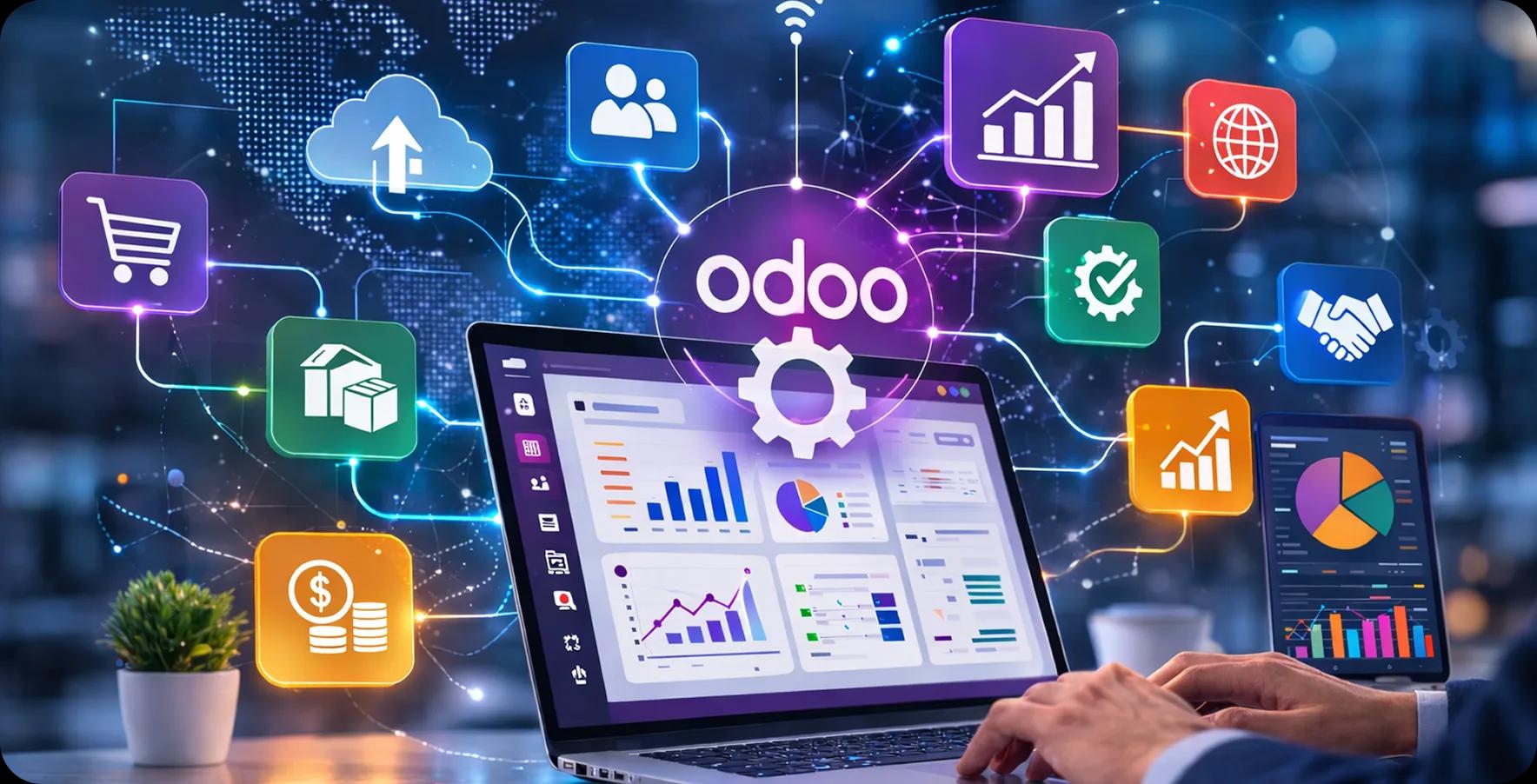
Quick summary: Fragmented business systems create duplicate work, delayed reports, inconsistent data, and operational blind spots. This guide explains how Odoo integration connects ERP, CRM, finance, inventory, HR, eCommerce, and regional services into one ecosystem. It covers integration services, partner selection, GCC requirements, industry use cases, and a five-step deployment roadmap.
In competitive Middle Eastern markets, where Vision 2030, UAE Centennial 2071, and rapid digital transformation agendas are reshaping entire industries, fragmented systems are no longer a minor inconvenience. They are a strategic liability. According to Gartner, businesses lose an average of 20 to 30% in revenue annually due to inefficiencies caused by siloed systems and poor data integration. Meanwhile, ongoing regional instability continues to disrupt supply chains, trade corridors, and cross-border commerce, so decision-makers across the GCC can no longer afford operational blind spots.
This is where Odoo integration can make a meaningful difference. By connecting ERP, CRM, inventory, HR, accounting, and eCommerce in one real-time ecosystem, Odoo eliminates data silos, automates workflows, and gives leadership the visibility to make faster decisions.
Partnering with the right Odoo development and integration company means implementing a solution that is technically reliable and aligned with regional compliance, language, and operating requirements. The following sections explain the hidden costs, core integrations, deployment roadmap, and outcomes leaders should evaluate.
1. Is Your Business Running in Silos?
Many enterprises believe their systems are connected until a critical decision is delayed because the information lives in different platforms. Siloed operations mean ERP does not communicate with CRM, warehouse software does not synchronize with invoicing, and leadership makes decisions using yesterday's spreadsheets.
In fast-moving GCC markets, that gap is not only inefficient; it introduces operational risk.
The Hidden Cost of Disconnected Systems in the Middle East
Disconnected systems create drains on profitability, employee productivity, and customer satisfaction that may not appear clearly on a balance sheet. For organizations operating across Saudi Arabia, the UAE, Qatar, Kuwait, Bahrain, and Oman, these costs are amplified by multi-currency processes, VAT requirements, and regional logistics.
Common hidden costs include:
-
Duplicate data entry consuming 15 to 25% of employees' working hours
-
Delayed financial reporting caused by manual consolidation
-
Inventory discrepancies between warehouse, sales, and procurement systems
-
Customer-service failures caused by CRM and fulfillment mismatches
-
Compliance risks from inconsistent VAT records
-
Poor demand forecasts based on fragmented sales and supply-chain data
-
Slow onboarding caused by disconnected HR and payroll systems
-
Leadership decisions based on outdated, manually compiled reports
-
IT overhead from maintaining multiple licenses, vendors, and integrations
2. What is Odoo Integration, and Why Does It Matter?
Odoo integration connects Odoo's modular ERP platform with existing third-party tools, including legacy ERP systems, payment gateways, eCommerce storefronts, logistics APIs, tax portals, and custom applications. Connections may use REST APIs, XML-RPC, webhooks, EDI, or middleware.
The objective is a single source of truth that synchronizes data across business functions in real time and eliminates the silos that slow decisions and increase costs.
One Platform, Every Department, and Fewer Gaps
Imagine the sales team closes a deal in CRM. Inventory is immediately reserved, an invoice is generated, the warehouse receives a pick order, and the finance dashboard updates. That is an integrated Odoo workflow.
Odoo's open architecture supports bidirectional data exchange, backed by over 40,000 pre-built modules available on the Odoo App Store. For Middle Eastern enterprises, this means a procurement team in Riyadh, a logistics hub in Dubai, and a finance office in Doha can all operate from a single, synchronized platform, with multi-company operations, multi-currency transactions, and multilingual interfaces—including Arabic—so teams across locations work with synchronized information.
The result is fewer version conflicts, faster reporting, and better operational intelligence.
3. Core Odoo Integration Services That Drive ROI
The most valuable integrations are designed around the organization's actual architecture. They connect the systems employees use most, automate work that consumes time, and expose information that supports profitable decisions.
From Finance to Fulfillment: What Gets Connected
A comprehensive Odoo integration strategy may connect:
-
Banking portals, payment gateways (such as PayTabs, Telr, and Stripe), and automated reconciliation
-
Tax-authority portals and VAT reporting workflows
-
Third-party logistics providers and warehouse-management systems
-
Customs, shipping, fleet, and last-mile delivery platforms
-
Salesforce, HubSpot, or another external CRM
-
Shopify, WooCommerce, Amazon, and other commerce channels
-
Biometric attendance, payroll, benefits, and labor portals such as Saudi Arabia's GOSI or the UAE's MOHRE
-
Procurement, supplier, and electronic-data-interchange systems
-
Business intelligence, analytics, and document-management platforms
The outcome is a connected environment where information flows from customer inquiry through fulfillment, invoicing, and financial reporting.
4. Choosing the Right Odoo Integration Company
Vendors may claim Odoo expertise, but the meaningful differentiators are technical depth, regional knowledge, delivery discipline, and post-launch support. A poor choice can lead to delays, cost overruns, and operational disruption.
What Middle Eastern Decision-Makers Should Look For
Evaluate potential partners against these criteria:
-
Verified Odoo expertise: Confirm they are an official Odoo Partner (Silver, Gold, or Ready) — this confirms verified technical expertise and direct access to Odoo's support ecosystem.
-
Regional compliance knowledge: Look for practical knowledge of GCC VAT laws, Saudi e-invoicing (ZATCA Phase 2), UAE FTA requirements, and local labor regulations.
-
Arabic localization: Confirm support for right-to-left interfaces, Arabic reports, and bilingual documents.
-
Relevant industry experience: Request case studies from retail, manufacturing, logistics, real estate, healthcare, or the applicable sector.
-
API and middleware capability: Assess their ability to build custom connectors using REST API, XML-RPC, and middleware platforms like MuleSoft or custom Python bridges.
-
Post-launch support: Define response times, escalation paths, ownership, and coverage during critical operating periods.
-
Data-migration methodology: Understand how legacy records will be profiled, cleansed, mapped, migrated, and validated.
-
Scalable architecture: Ensure the solution supports future companies, warehouses, currencies, products, and locations.
-
Security and privacy: Especially important for businesses with government contracts or sensitive customer data, verify GDPR, ISO 27001, and local data sovereignty compliance.
-
Dedicated delivery capacity: Confirm that when you hire Odoo developers through them, you get a dedicated team, not generalist resources juggling multiple clients simultaneously.
-
Transparent pricing: Require a clear breakdown of licensing, implementation, customization, training, support, and maintenance.
5. Industry-Specific Integration Wins
Odoo's strength lies in its adaptability. A modular architecture allows the platform to fit different workflows rather than forcing every organization into one process.
Retail, Logistics, Manufacturing, and Beyond
Retail: Odoo connects POS, eCommerce, loyalty, procurement, and inventory. Teams receive real-time stock visibility across physical stores and online channels. Retailers report up to 35% reduction in stockouts and a 40% improvement in order fulfillment speed post-integration.
Logistics and freight: Integrations connect fleet management, GPS tracking, customs, warehousing, carrier APIs, and last-mile delivery. Operations teams gain a live view of shipments, cost centers, exceptions, and service levels.
Manufacturing: Odoo MRP can connect production planning, IoT data, quality control, maintenance, purchasing, and supplier portals. This supports automated replenishment, traceability, and real-time production-cost analysis.
Real estate: Developers and property managers can connect project management, contracts, billing, maintenance, and facilities workflows.
Healthcare: Networks can connect patient administration, pharmacy inventory, insurance billing, purchasing, workforce scheduling, and financial reporting while applying appropriate privacy controls.
Across these sectors, integrated information consistently provides better visibility than isolated systems.
6. Odoo Integration Across the GCC
The GCC has operational, regulatory, and cultural requirements that generic ERP implementations may not address. A specialized regional partner understands that deploying Odoo in Riyadh, Dubai, Doha, or Manama requires different compliance and localization decisions than deployment in another region.
VAT Compliance, Arabic Support, and Local ERP Realities
VAT and e-invoicing are important requirements across GCC markets. A correctly configured Odoo environment can automate tax calculation, generate compliant invoices, maintain audit trails, and connect to relevant government services where supported.
Arabic support involves more than translating labels. It may require:
-
Right-to-left interface rendering
-
Arabic-language financial and operational reports
-
Bilingual invoices and customer documents
-
Local date and number formats
-
Hijri calendar support where required
Regional deployments may also integrate with government portals such as Saudi Arabia's GOSI (social insurance), Mudad (salary protection), Qiwa (labor), and the UAE's Wage Protection System. Businesses operating under free-zone regulations — DIFC, ADGM, JAFZA — have additional reporting requirements that should be included in discovery rather than added as late-stage patches.
7. The Integration Roadmap: From Discovery to Deployment
A structured, phased approach separates a controlled Odoo deployment from a costly one.
Step 1: Discovery and Audit
The partner audits systems, data structures, workflows, user roles, security requirements, and integration touchpoints. This phase maps required connections and defines scope, milestones, responsibilities, risks, and success metrics.
Expected outputs include:
-
Current-system inventory
-
Data-flow and integration diagrams
-
Requirements and gap analysis
-
Project charter, milestones, and risk register
Step 2: Architecture and Design
The technical blueprint defines middleware, API protocols, data models, module configurations, custom development, and third-party connectors.
Expected outputs include:
-
Integration architecture
-
Database and field mapping
-
Data-migration and reconciliation plan
-
Module selection and customization specification
-
Security and access-control model
Step 3: Build and Configure
The delivery team builds connectors, configures Odoo modules, establishes multi-company or multi-currency environments, and conducts initial migration runs in a staging environment.
Expected activities include:
-
Iterative development with progress reviews
-
Migration dry runs and reconciliation reports
-
Regional VAT, language, and government-service configuration
-
Workflow automation and role configuration
Step 4: Test and Validate
Teams conduct user acceptance testing across integrated workflows before production deployment. Testing should cover end-to-end scenarios, integration failures, peak loads, permissions, security, and data integrity.
Expected outputs include:
-
Cross-departmental UAT results
-
Performance benchmarks
-
Security and access review
-
Data-integrity validation
-
Cutover readiness approval
Step 5: Deploy and Support
Deployment follows a documented cutover plan with monitoring, training, and a defined hypercare period. A phased rollout can reduce disruption when the organization has multiple sites or business units.
Expected activities include:
-
Controlled production cutover
-
Post-launch monitoring and issue resolution
-
End-user and administrator training
-
Hypercare support for the initial operating period
-
Handover documentation and continuous-improvement backlog
8. Real Numbers and Measurable Results
Decision-makers need more than promises; they need proof. The business case for Odoo integration services is well-documented across industries and geographies. According to Nucleus Research, ERP systems deliver an average ROI of $7.23 for every dollar invested, with integrated platforms consistently outperforming standalone deployments. The numbers from GCC-based deployments tell an even more compelling story.
How Businesses Cut Costs and Scale with Odoo Integration
A mid-sized UAE-based logistics company reduced manual data entry costs by 60% within six months of deploying a fully integrated Odoo environment connecting their fleet management, warehouse, invoicing, and customer portals. A Saudi retail chain with 18 stores achieved real-time inventory visibility across all locations, reducing stockout incidents by 42% and improving sell-through rates by 28% in the first year.
A Bahrain-based manufacturing firm that chose to hire Odoo developers for a custom MRP-to-procurement integration cut its procurement cycle time from 14 days to 3 days, a 79% reduction, while simultaneously improving supplier payment accuracy to 99.4%. These are not edge cases; they represent the consistent outcomes that structured Odoo integration delivers when implemented with the right expertise and regional understanding.
The financial impact extends beyond cost savings: faster order-to-cash cycles improve working capital, integrated reporting reduces the finance team's monthly close time by up to 70%, and real-time dashboards empower leaders to make decisions in hours rather than days. Integration is not an IT project; it is a competitive advantage.
9. Your Next Move Starts Here
The evidence is clear: businesses that operate on integrated, unified platforms consistently outperform those running on disconnected systems, in efficiency, profitability, compliance, and scalability. For Middle Eastern decision-makers navigating a landscape of regulatory change, regional volatility, and digital transformation pressure, the question is no longer whether to integrate; it is how fast the organization can do it strategically.
The right Odoo integration company does not just deploy software; it architects the operational backbone of business growth. A partner with deep GCC expertise will ensure the integration is VAT-compliant from day one, Arabic-ready across every module, and resilient enough to scale with the organization's ambitions, whether that means expanding across the Kingdom, entering new GCC markets, or optimizing operations for the demands of a shifting regional economy.
Do not let disconnected systems limit the organization's potential. Connect the business, unify the data, and lead with confidence. The most transformative business decision made this year might just be choosing the right integration partner.

Written by
Pratik Kantesiya
AI Engineering Lead
Pratik leads AI engineering at Agile Infoways, where he architects production AI systems for enterprises across healthcare, BFSI, and logistics. He writes about practical AI delivery — what works, what does not, and what most teams miss between proof-of-concept and production.